
Capturing the ‘real’ – A search for reality in contemporary Dutch photography
Author: Grietje Hoogland
MA Comparative Arts and Media Studies at the Free University Amsterdam
Year: 2011
Teacher: Ivo Blom
The idea that reality can never be captured objectively intrigues me. This has first been said by the philosopher Immanuel Kant, and still doesn’t seem to be disproved.[1] He stated that we can only capture representations of reality, and that reality itself can never be known.
In art history it has been very common to capture reality: great kings and conquerors were painted as to preserve them for the future. Once photography came up in the 1830s, an incredible shift can be noticed in painting: due to the use of photography a lot more was possible in depicting reality.[2] But photography didn’t just become an aid to help painters represent reality; photography also became an art. Of both artistic and ‘neutral’ (representing) photography the question can be asked:
Can photography objectively capture reality?
After opening this essay with Kant, answering this research question seems quite a challenge. To find this out, I will look at the work of five contemporary Dutch photographers: Hellen van Meene, Carla van de Puttelaar, Hendrik Kerstens, Alex ten Napel and Hans Eijkelboom, and at the way they capture reality, or certain aspects of reality. They all have in common that they photograph the human figure, but all five of them do so in a different way. I will show photographs of these photographers in order to show how they look at, and work with, reality. Do they try to be objective, or do they think it is impossible anyway, focusing instead on the aspects they think are more important? Before introducing the photographers, I will look at the traditions of, and visions on the representation of reality, constituting a framework to place these photographers in. After that, I will show how these photographers fit in this framework and see if reality is ‘capturable’ or not.

Traditions and visions on reality
In my introduction I wrote that photography not only developed as an aid for painters, soon it was also recognised as an art form. The technique of photography emerged in the 1830s. By the 1870s painters already made use of it in their work, though it was kept hidden, and at the end of the 1880s and beginning of 1890s a few painters, amongst them Jules-Alexis Muenier, saw not only painting, but also photography as an art. He even showed both his paintings and photographs in exhibitions.[3] Since then, photography developed as a technical medium, as an iconic medium that tries to represent reality, and as an art form. But of course, as will also be the case with the photographers I chose, these last two are difficult to distinguish: there is very fine line between representational photography and photography as an art, giving room for views and opinions.
According to James Lastra, in ‘From the Captured Moment to the Cinematic Image’ (1997) the same development can be seen in painting, cinema and photography: in the early days of the medium a distinction was made between images with ‘randomly placed figures’, and ‘real art’, which are images with a clear composition. So also in photography, in the 1890s, it was seen as ‘real art’ when photographs had immediacy, clarity and narrative unity. [4] This tension between the ‘real’ and the ‘staged’, the latter being the ‘real art’, has been apparent ever since.
There have been different approaches to deal with images. In his ‘A Preface to Disputation’ (1997), Dudley Andrew sums up the most important ones, among which the ontological and semiotic approach, and the politics of representation. I will go deeper into these three notions, adding other authors to make it more complete.
Ontological approach
“As things in nature, the photographic arts are perhaps not arts at all, but proleptic sensorial assists,” Andrew says in his article.[5] In a way you could say that the camera is seen as an extension of our senses, in this case our visual perception. This is an interesting notion to start with, because it is close to our research question. Seeing a photo camera as an extension of our sight, one might think that if we can register reality with our eyes, the camera can do that as well. If both our senses and the extensions of our senses capture reality the same way, and with the same quality, Andrew does not say.
Roland Barthes seemed to have had the idea that the quality of the photograph stays the same: “Certainly the image is not the reality but at least it is its perfect analogon and it is exactly this analogical perfection which, to commonsense, defines the photograph. Thus can be seen the special status of the photographic image: it is a message without a code.”[6] So he states that the photograph is not reality itself, but a perfect analogy of reality, a message without a code, which indicates that you don’t have to learn a language to understand a photograph.
I tend to disagree with Barthes. A photograph can never be an analogical perfection in capturing reality, in the first place because of its borders. A photograph has a square frame, and outside of it, the image stops. The photographer selects what is inside the frame. There already we have a subjective aspect that colours what we see of reality, namely what the photographer wants us to see. But I think also seeing with our eyes alters reality, just like Kant said: reality cannot be known. The artist Joan Fontcuberta, who spoke at the LifeLike symposium held at the Van Gogh Museum in 2010, confirms this. He goes even that far as to say that photography is fiction.[7] How he looks at our own perception of reality is not clear, but I think Andrew’s idea that the photo camera is an extension of our senses seems to me like a solid statement. But we should keep in mind that both our senses and the extensions of it, are subjective.
Semiotic approach
Roland Barthes stated that images always have a relationship with verbal text. In his opinion images can have too many meanings, so you need verbal language to narrow these meanings down to one.[8] Kress and Van Leeuwen, authors of “Reading Images, The Grammar of Visual Design” (1996), already showed they disagree with this notion. They see images as a language of its own, just as verbal language is: they are two different forms of representation.[9] I agree with them, I think it is obvious that images can stand on their own, without verbal ‘translation’.
But then, how to ‘read’ images, and photographs in particular? In his book “Caged in our own signs” (1996), semiotician Kyong Liong Kim noted that there are three ways in which an image can relate to reality: as a symbol, an index and an icon.[10] As a symbol, that what is shown in an image ‘stands for’ something else. The reader should have the right tools to ‘crack the code’, and to understand what is meant, just like we learn that a red sign in the street means ‘stop’. An index refers to something that is not visual in the image itself. Just as smoke indicates there is fire somewhere, a photograph can refer to an external reality, outside the frame. And thirdly, the icon is the easiest: it shows directly in the image what it refers to. If you see an image of a house, it refers to ‘house’.
Andrew states that photographs are difficult to read semioticly, because, as he says, the indexical function outweighs the iconic function.[11] I am not sure if that is true: we should at all times consider if we are looking at a picture on an iconic, indexical or symbolic level, but I think, and we will see this when I discuss the work of the five photographers, all three can be present, and they all can carry meaning without standing in each other’s way.
Politics of representation
In his article Andrew stated that we live in an image society. In image production and reception nowadays, we give room to a lot of political and social debates. To put it differently: a lot of images we see everyday comment on things that are happening in our society.[12] This is what Andrew calls the politics of representation, and we should consider this approach here as well: the possibility of the photographer to deliberately add opinions to a photograph. But it works on the level of perception as well: the ‘reader’ of the photograph can see views or opinions in pictures, even when the photographer didn’t deliberately put them there. It is something photographers have to be careful with as well, like Jasper de Beijer, a photographer who also spoke at the LifeLike symposium, put it: “I get 95% from the audience; I only have to add 5%”.[13] This 95% is the perception of the viewer, and you work with shared believes and opinions to make it work. This way, the ‘message without a code’, that Barthes spoke about, is certainly not true: photographer and ‘reader’ both have to speak the same visual language to deliver the right message, while on its way a lot can go wrong.
To give more practical examples, I will briefly introduce five photographers and show how their relationship with reality works. After that, I will try to fit their work into the ontological and semiotic approach and – if necessary – the politics of representation.
Depicting the human figure
I have chosen five photographers who portray the human figure in a very distinctive way. By keeping the art form – photography – and the object of representation – the human figure – the same, I hope I can make distinctions on only one level: the visions of the different photographers.
Hellen van Meene (1972)
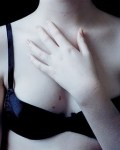
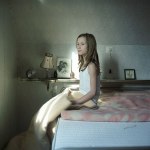
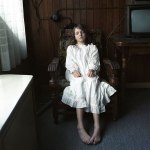
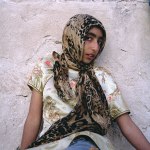
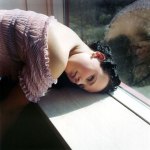
Hellen van Meene is a photographer who portrays mostly young people. Sometimes she makes portraits, but she also places adolescent models in intriguing interiors. Her photographs are often attracting and at the same time a bit alienating, the young women (which they mostly are) in these interiors are often in their own world, making you wonder what or whom they are thinking of. Van Meene is interested in the way in which young adolescents are still open to life, in her opinion more than adults are, and she wants to show that in her pictures.[14] She starts from observation to show the reality of the girls and women she portrays. This reality can be in various things: in looks, movements, or the placement of a hand. But although the setting of her photographs mostly seem spontaneous, she arranges everything, like she says: “to the smallest detail, such as the nail polish on their fingers.”[15] She is very interested in what happens when you place a model in a certain environment: the model reacts on it, but the environment also reacts on the model.[16] So Van Meene, though portraying very real people and emotions, doesn’t leave anything to fate, there seems to be friction between reality and fiction.
Carla van de Puttelaar (1967)
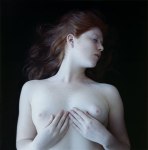
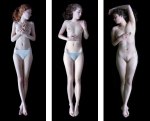
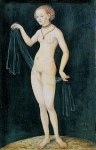
Another photographer who works with the reality of women is Carla van de Puttelaar. In her work she portrays the female nude as it is, without using Photoshop. This means that she deliberately shows little scratches, moles, goose bumps and everything else the skin shows. These are exactly the things that are always wiped away in magazines, and which according to Van de Puttelaar reveal the true human beauty.[17] She places women against a black background, and mostly they have their eyes closed so they seem to be in their own world. Although she doesn’t change a thing after developing the photos, she does something while developing the pictures, to give the photos a cool and soft glance. About this she says: “That developed gradually. (…) I never liked harsh, very vivid colors, but I also wanted to avoid the trap of false romance. I liked the paleness of the skin and wanted to increase it. This also enables me to give greater contrast to skin’s small marks and sensations.” So she tempers with the outcome of the picture to make it more intense. What is also visible in her work, is her interest in the work of Dutch old masters, especially Lucas Cranach the Elder.[18] So although Van de Puttelaar stages the model and uses a technique to change the feel of the outcome, she refers very directly to the reality of the woman, and the rich history of portraying people.
Hendrik Kerstens (1956)
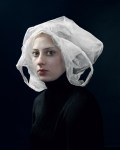
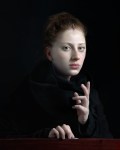
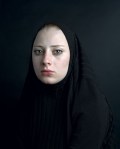
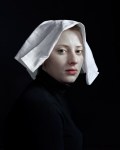
Hendrik Kerstens also refers to the old masters with his photography. He makes portraits of his daughter Paula, often with dark clothes on, against a dark background. Mostly she has one simple attribute that strongly refers to something outside the picture. A strong image is ‘Bag’, a photo in which she has a plastic bag on her head. It seems to refer to two different things: to our consumption society in which we wrap and throw away a lot of things, but also to portraits by Dutch seventeenth century painter Johannes Vermeer. Most of the photographs refer to the images we all know of the seventeenth century, by only using a prop like a hairnet, a towel, a sweater or aluminium foil. The website of his gallery (Witzenhausen Gallery) says: “Not only does he picture her in relation to events in her own life, he also projects on her his fascination with the dutch painters of the seventeenth century.”[19]
The photographs of Kerstens are also posed and staged, just like the photographs of the artists I have already mentioned, so they don’t capture reality, but they certainly refer to it and comment on it, so there is a relation to reality.
Alex ten Napel (1958)
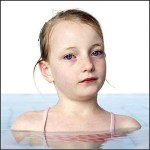
Alex ten Napel also specializes in making portraits. He has made quite some intriguing photographic series during his career, and they all have in common that in the photos, he focuses on showing the character of the portrayed, their emotions and expressions. One very interesting series of photographs is the water portraits. Ten Napel started out photographing men and women in a swimming pool, where they are stripped from their clothes, their external identities. He says about this:
“The virtually-naked men and women in bathing suits did not seem to have any aesthetic relationship to their real lives: disorderly hair, lack of clothes, they became human beings in a natural state in perfect harmony with the water. It was only later, when I actually selected the photos, that I noticed how much more expressive the children were than adults. Their faces communicated so much feeling that I was won over.”[20]
If you look at his photographs you see how beautiful their facial expressions are. You can see if they feel comfortable in the water or not, if they are cheerful, shy, proud or dreamy. Ten Napel touches, I think, upon a very personal human reality.
Hans Eijkelboom (1949)
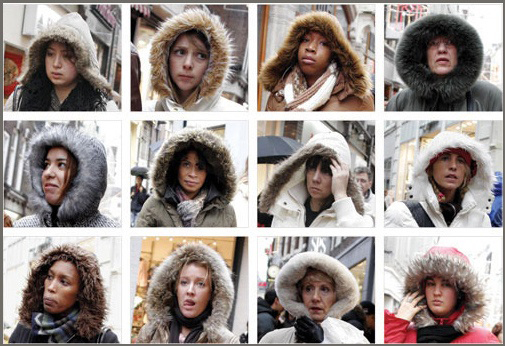
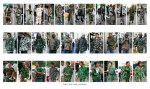
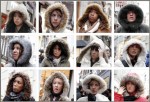
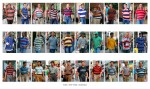
Hans Eijkelboom has a different approach. He has a camera on his neck, and with his hands in his pockets he controls the button. He looks for the opposite of what Ten Napel looks for: he doesn’t want to strip people from their external identities, he wants to show them. With the ‘hidden’ camera, he watches people go by in the city and photographs people that wear the same type of clothes.[21] Afterwards, he puts them in a row in order to show this public, shared identity. The outcome is often very humorous, but it clearly and painfully shows how we put our own identities aside to fit in with the rest.
Concerning reality, we can say that the previous four artists stage their photographs, and therefore also their outcome, while Eijkelboom doesn’t. He registers reality in snapshots, so visually he seems to be closer to reality than the others. But is he? He has a clear agenda that is already seen in the subjects he chooses. And then, by making series of them, his ideas become very clear. You obviously see his own interpretation of reality.
It seems to be that all five artists have a dual relationship with reality. They show parts of it, and hide other parts. They refer to it, comment on it or let the viewer watch. In the next chapter I will use the works of these photographers to see if it is possible to show anything of reality at all.
Dealing with reality
The five photographers I chose all have a different relationship with reality. With the three different approaches I mentioned in the first part: the ontological and semiotic approach and the politics of representation, I will try to figure out how exactly these relationships can be defined.
The ontological approach, seeing a photograph as an extension of our senses, obviously seems relevant for all five photographers, because photographing is what they do. But I think some photographers work with the medium as if it were an extension of their senses more than others do. Extending your senses implies that the act of photographing is mostly ‘looking’ at your subject, and capturing it for others to see, because that is the advantage of using a camera. Of course Hans Eijkelboom is in that sense a very good example: he uses the camera in the streets to show other people what he observes. In his work you could really state that his camera is an extension of his sight. Also for Alex ten Napel this could count, who tries to capture the identities of his subjects, pulling the viewer towards the facial expressions of his models. But of course the other photographers, though they stage the setting thy photograph, also have an element of ‘extending’ sight. Carla van de Puttelaar said how in magazines the human skin, which is mostly photoshopped into a smooth surface, intrigues her. She wants to show the beauty of the skin as she sees it. And Hellen van Meene said herself that a good photograph starts with observation. Come to think of it, the work of Hendrik Kerstens seems to be the least ontologically approachable, because the strength of his work lies in the reference to the Dutch history. But also in his work it is shown that he gives delicate attention to a lot of visible aspects such as mise-en-scène and lighting, so also Kerstens not only seems to give meaning to his photos, but also has the aim to show what he observes.
The ontological relation to reality is an interesting one because now we can see that all photographers can be seen this way However in showing how they observe, it is suddenly clear that the connection with reality is their vision on reality. The works of these five photographers confirm that a registration of reality cannot be objective.
As I mentioned, the semiotic approach is divided into three parts: that of the symbol, the index and the icon. These five photographers all work on different levels, sometimes more than one. As to the symbol, it is less of a subject in photography to depict signs and other symbolic meaning carriers. But I think it is found in the work of Hans Eijkelboom: he portrays people with different styles of clothing, and these clothes are meaning-carriers. Especially by putting series of images together of people with the same type of clothes, the meaning of these clothes (the house fathers in polo shirts, the ‘gangster’ in camouflage clothing etc) is even more stressed and you could say that it is a symbolic meaning carrier. The work of Hellen van Meene seems above all to have an iconic meaning: you are invited to just look at the scenery, at the model, at the situation. It doesn’t seem to refer to any external reality, and that is, I think, a very strong quality. Alex ten Napel works in an iconic way too: he also invites you to look closely to what you see. As he strips his models from all external identity, he exposes a lot of meaning that the models already carry themselves. No external references are needed. Carla van de Puttelaar works this way too, showing her models like they are, and the skin is a very important aspect of her work. But apart from the iconic meaning, she also has an indexical meaning in her work. Like I mentioned, Van de Puttelaar is influenced by old masters like Lucas Cranach the Elder, and that is visible in her photographs. So her photographs carry both an iconic and indexical meaning. The only photographer who is mostly concerned with indexical meaning is Hendrik Kerstens. He makes his photographs deliberately with a connection to the Dutch visual history, which the ‘reader’ will most probably notice because he shows a commonly known history. But putting his work only in the category of the index would do his photographs no right: I think (like I said before) his work is also of a delicate beauty that in itself is worth looking at. So I would also consider his work to have an iconic message.
With these five photographers all three of the semiotic approaches are present. It seems that the symbol, index and icon all have their own relationship with reality: the symbolic meaning of Hans Eijkelboom’s work refers to social codes, the work of the others strongly stress the reality of what is seen in front of the camera, and the works of Van de Puttelaar and Kerstens also refer to an external reality: that of our visual history. So although ontologically seen there is no possibility to capture reality, they all have a relevant relationship with reality.
In their work, three of the photographers I research deal with the politics of representation. Hendrik Kerstens, Carla van de Puttelaar and Hans Eijkelboom comment on current issues in society, but all in very different ways. Eijkelboom for instance, shows how we neglect our own identity to fit in, by showing series of people who dress the same. Van de Puttelaar comments on the way women are portrayed in the mass media, but in her case by showing the female beauty without idealizing or manipulating it. In a way, also Ten Napel does this, by stripping people from their clothes and reveal their personality, but I think in his case he is mostly concerned with what he sees in front of his camera, without any external references. Also Kerstens seems to refer to things that are happening now: he often used garbage (plastic bags, aluminium foil) as a hat or hairdo for his model, which can be seen as a comment on how we treat our foods and waste nowadays.
Speaking in terms of Andrew’s politics of representation, these comments on reality, made by these photographers, can only be visible when the photographer speaks about it in interviews, or when the audience recognises it. The comments on beauty and identity of Eijkelboom and Van de Puttelaar therefore I have found in interviews and other articles, whereas the comments of Kerstens on our behaviour towards wase, I didn’t find explicitly in the literature. Still I think it could be valid, seeing the large amount of waste objects he gives a prominent role in his work.
The power of the recognition of the audience must not be underestimated: the power of an image stands and falls with the recognition of the viewer. Like artist De Beijer said: “I get 95% from the audience; I only have to add 5%”. The work of the artists I mentioned also proves that Barthes’ ‘message without a code’ in photography is not true, because in these examples we see that you need a visual language to uunderstand these comments that are made. This makes the photographs even more interesting in the interplay of the politics of representation: they are in a difficult field of production and reception, in a society that continuously changes.
Conclusion
In my essay, I have looked at three different approaches to deal with the question if reality can ever objectively be captured. I started with Kant, who already stated that reality cannot even be known, let alone capturing it. This is an interesting statement to start with, because bij Kant, my question seemed already to have been answered. But through the works of Hellen van Meene, Carla van de Puttelaar, Hendrik Kerstens, Alex ten Napel and Hans Eijkelboom, I hope to have shown that there are a lot of nuances between reality and fiction, making it possible to show bits and pieces of a reality.
In my ontological approach, the words of Kant were soon confirmed. It was very clear that what the photographers captured of reality was their vision on reality, so objectivity seemed to be impossible. This also raises questions on Barthes’ statement that photography is an ‘analogical perfection’ in capturing reality, erasing views and visions of the photographers for a moment, we still deal with the borders of the photograph, and the choice of the photographer where to aim at, so objectivity is not possible.
Showing the semiotic relationship the five photographers had with reality, it became clear that although reality itself cannot be caught, some aspects of reality can be shown, or be referred to. Splitting their imagery up into a symbolic, indexical or iconic relation to reality, all photographers turned out to touch upon very relevant aspects of reality, whether it was directly shown in the photographs, or referred to in one way or another. Staging the work or shooting exactly what you see doesn’t seem to make a difference.
Finally I stressed once more that the role of the viewer cannot be overlooked, it makes a lot of difference in giving meaning to a photograph. Looking at the politics of representation, we saw how some of the photographers gave comments on society, which they sometimes explained in interviews, but not always. It is necessary for the photographer and the viewer to speak a language to add and extract comments on society. Seeing it this way, reality is not only to be captured by the photographer, it is also to be extracted by the viewer.
Answering my research question: Can photography objectively capture reality? I would say: no. Kant has a very strong point when he states that objectively capturing reality is not possible. But I like to add a nuance, in saying that a photographer can tell very important things about reality. And viewing a photograph, though highly subjectively, we may even get a little glimpse of it.
[1] Kim, 1996, pp.33-34
[2] Weisberg, 2010, p.32
[3] Weisberg, 2010, pp.31
[4] Lastra, 1997, pp.263-265
[5] Andrew, 1997, p.ix
[6] Kress, 1996, pp.22-23
[7] http://www.youtube.com/watch?v=um44QlXDSnQ&feature=related, jan. 2011
[8] Kress, 1996, p.20
[9] Ibid. p.20
[10] Kim, 1996, pp.19-21
[11] Andrew, 1997, pp.x-xi
[12] Andrew, 1997, pp.xi-xii
[13] http://www.youtube.com/watch?v=afvLGloWQ0M&feature=related, jan. 2011
[14] http://jmcolberg.com/weblog/extended/archives/a_conversation_with_hellen_van_meene/, jan. 2011
[15] http://hellenvanmeene.com/biography/interviews/, jan. 2011
[16] Ibid.
[17] http://blog.photoeye.com/search/label/Carla%20van%20de%20Puttelaar, jan. 2011
[18] http://blog.photoeye.com/search/label/Carla%20van%20de%20Puttelaar, jan. 2011
[19] http://www.witzenhausengallery.nl/artistbio.php?idxArtist=12, jan. 2011
[20] Franzoni, 2007, pp.7-9
[21] Book presentation at ‘De Anatomische Les 2010’, 18 november 2010
Literature
- Andrew, D., ‘ A Preface to Disputation’, in: The Image in Dispute. Art and Cinema in the Age of Photography, University of Texas Press, Austin 1997
- Denys, D., Goede bedoelingen en modern wonen, book presentation at ‘De Anatomische Les 2010’, Concertgebouw Amsterdam, 18 januari 2010
- Franzoni, C., Zoom Magazine, ‘Alex Ten Napel’, Zoom Magazine, Milano, 2007
- Kim, K.L., Caged in Our Own Signs: A Book about Semiotics, Ables Publishing, London, 1996
- Kress, G., Leeuwen, T. van., ‘Reading Images, The Grammar of Visual Design’, Routledge, New York, 1996
- Lastra, J., ‘ From the Captured Moment to the Cinematic Image. A Transformation in Pictorial Order’, in: Dudley Andrew ed., The Image in Dispute. Art and Cinema in the Age of Photography, University of Texas Press, Austin, 1997
- Weisberg, G., et.al., Illusions of Reality: Naturalist painting, photography, theatre and cinema, 1875-1918, Mercatorfonds, Brussels, 2010
Websites:
- Colberg weblog, Conversation with Hellen van Meene, http://jmcolberg.com/weblog/extended/archives/a_conversation_with_hellen_van_meene/, jan. 2011
- Hellen van Meene, Interviews, http://hellenvanmeene.com/biography/interviews/, jan. 2011
- Photo Eye, Carla van de Puttelaar, http://blog.photoeye.com/search/label/Carla%20van%20de%20Puttelaar, jan. 2011
- Witzenhausen Gallery, Biography Hendrik Kerstens, http://www.witzenhausengallery.nl/artistbio.php?idxArtist=12, jan. 2011
- Youtube, Joan Fontcuberta, http://www.youtube.com/watch?v=um44QlXDSnQ&feature=related, November 2010
- Youtube, Jasper de Beijer, http://www.youtube.com/watch?v=afvLGloWQ0M&feature=related, November 2010
All images are taken from the websites mentioned above.
 Grietje M. Hoogland
Plaats een reactie